Author – Md Obaydul Haque
The UK international higher education sector faces a critical turning point as study visa issuance declines sharply, threatening both financial stability and cultural diversity. This change signals growing vulnerability for British universities. In response to this immediate crisis, university leaders should prioritise risk mitigation strategies, including conducting scenario planning to anticipate various enrollment outcomes, undertaking comprehensive financial modelling to assess the impact of revenue losses, and implementing urgent compliance audits to ensure institutions remain eligible for international student sponsorship. To drive these efforts, administrators can use established tools and frameworks, such as the Higher Education scenario-planning templates, Monte Carlo simulations for financial forecasting, and sector-specific risk registers. Taking these steps now will help stakeholders respond more effectively to rapidly evolving risks.
As the Labour government celebrates reduced net migration, stricter immigration policies create significant challenges for the higher education sector, forcing universities to confront long-term consequences.
The Numbers Behind the Decline: A 32% Drop in Visa Issuances
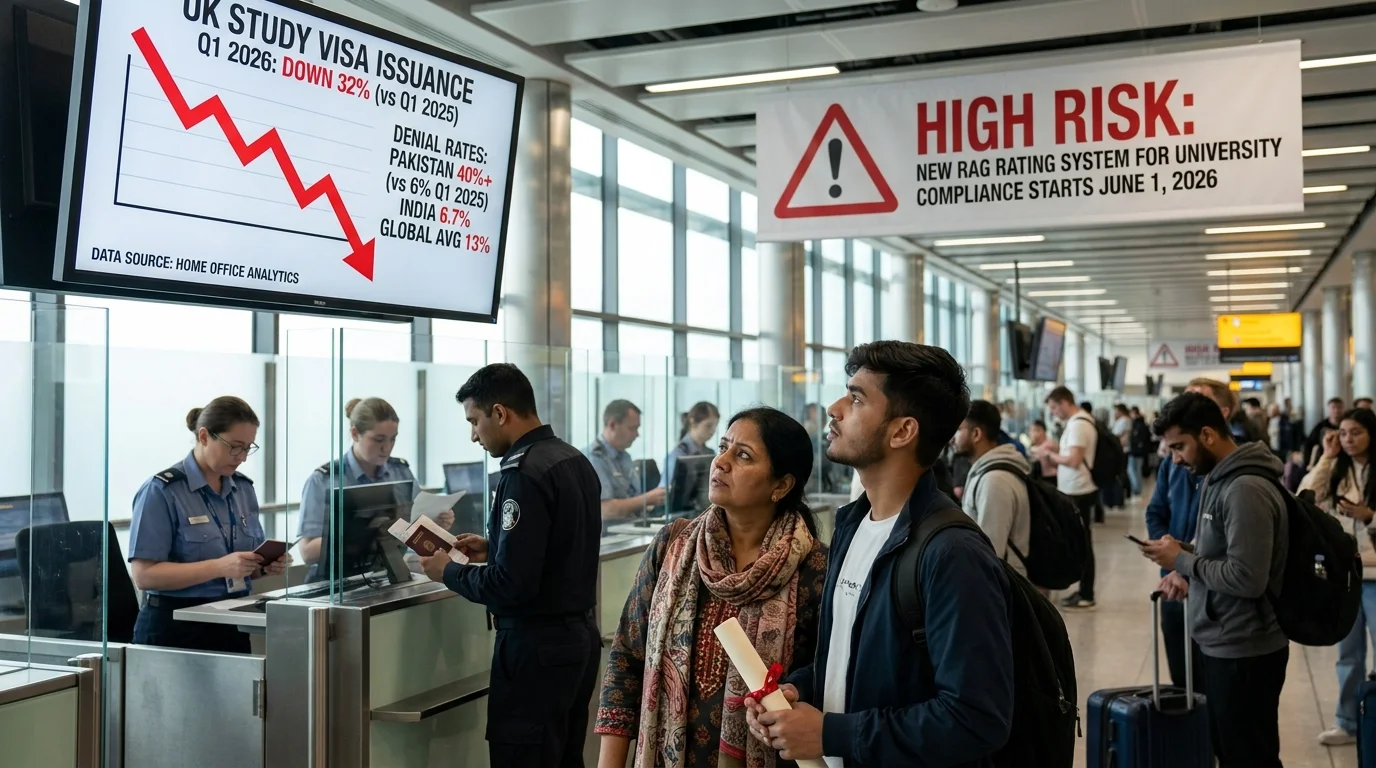
Home Office data show a significant drop in Q1 2026. Study visa applications fell 30% year-on-year. More importantly, actual visa issuances dropped by 32% due to high refusal rates starting in late 2025.
This downward trajectory is not an anomaly; it is the direct result of deliberate policy interventions aimed at curbing net migration.
Net Migration Hits Historic Lows
Student visa declines align with an ONS announcement: net migration to the UK dropped to 171,000 in 2025, the lowest since 2012 (excluding pandemic years).
Net Migration Milestone (2025): 171,000
– Lowest level since 2012 (excluding pandemic years)
– Nearly half of the total net migration was recorded in 2024
Home Secretary Shabana Mahmood called the figures a success, highlighting restored order to UK borders. The government attributes the 2025 drop in non-EU arrivals for work to restrictive policies, but Q1 2026 data show that international students are now feeling the impact of those policies.
Next, an examination of geopolitical disparities reveals shifts in the impact on the student market.
The global denial rate for UK study visas in Q1 2026 was 13%. However, data reveal wide disparities, with certain markets facing severe entry barriers.
The Crisis for South Asian and African Markets
Pakistan, currently the UK’s fourth-largest source of international students, has been the hardest hit by the Home Office’s tightened scrutiny.
- Pakistan: 40% of Pakistani applicants were denied study visas in Q1 2026. In Q1 2025, the denial rate was 6%, nearly seven times lower.
- Bangladesh, Ghana, Sri Lanka, and Nigeria each had visa rejection rates above 20% in the same quarter.
These regions have been important for UK universities, especially for postgraduate programs. The sudden rise in refusals signals tighter credibility and financial screening by immigration officers.
The Major Markets: India and China
India remains the UK’s single largest source market for international students, but it too is feeling the squeeze.
- India: Indian applicants saw a 6.7% denial rate in Q1 2026—a slight improvement from 8.6% in Q4 2025, but more than double the 2.9% rate in Q1 2025.
- China: Conversely, China remains an outlier. Chinese applicants maintained a near-flawless visa approval trajectory, experiencing a rejection rate of just 0.4%.
Bucking the Trend: Nepal’s Surprise Recovery
Nepal improved against the global trend. Combined rejection rates in Q4 2025 and Q1 2026 dropped to 4.6%, down from 11.3% the year before. This suggests successful adaptation to UK compliance requirements.
Institutional Panic: The Impending June 1 Compliance Deadline
The timing of this data is stressful for UK universities. Institutions are rushing to meet stricter compliance measures due June 1, 2026.
The Home Office is introducing an overhauled Basic Compliance Assessment (BCA) metric, which features a strict Red-Amber-Green (RAG) rating system. Under these new rules, the margin for error for universities sponsoring international students has practically vanished. The updated RAG thresholds mean that institutions will receive a ‘Green’ rating if their visa refusal rate remains below 10 percent, an ‘Amber’ rating if it falls between 10 percent and 15 percent, and a ‘Red’ rating if it is above 15 percent. Universities with a ‘Red’ status face immediate risk of losing their ability to sponsor international students. By understanding these thresholds, administrators can better assess their current risk and take targeted actions to prepare for the compliance deadline.
The New RAG Rating Thresholds for Universities
| Status Rating | Visa Refusal Rate Threshold | Institutional Implications |
| Green | Below 4% | Standard processing; maintained sponsor status. |
| Amber | Between 4% and 5% | Increased monitoring; mandatory review of recruitment practices. |
| Red | 5% or higher | Severe risk of losing Student Sponsor Licence; potential suspension of international recruitment. |
With a global denial rate of 13% and higher rates in India and Pakistan, universities face a real compliance crisis. Heavy recruiting from South Asia or West Africa could push institutions into the “Red” zone, risking their ability to secure sponsorships. To proactively adapt and maintain enrolment while minimizing compliance risk, institutions should diversify recruitment strategies. This may include expanding outreach to emerging markets in Southeast Asia, Latin America, or the Middle East that currently have lower refusal rates.
For example, China remains the largest low-risk market with a visa refusal rate of only 0.4% in Q1 2026. Nepal has also shown great improvement with a combined refusal rate of just 4.6% in Q4 2025 and Q1 2026. Other promising markets include Vietnam and Malaysia, both recording estimated visa refusal rates below 7%, and Mexico, which reported a 5% denial rate. By focusing efforts on countries with high approval rates, administrators can make data-driven recruitment decisions that support compliance and enrollment goals. In addition, universities can invest in digital recruitment platforms and virtual engagement tools to strengthen connections with prospective students worldwide and unlock new applicant pools.
New BCA metrics set tighter thresholds for enrolment and course completion, making universities responsible for student actions even after arrival in the UK.
The Ripple Effects: What This Means for the UK Higher Education Sector
Plummeting visa issuances alongside strict compliance rules threaten the viability of UK higher education, putting financial, cultural, and global competitiveness at risk. To ensure long-term sustainability, university leaders should consider adaptation strategies such as diversifying revenue streams,
for example, by exploring partnerships with industry, expanding online education, or increasing recruitment from domestic and European student markets. Universities may also wish to broaden their academic offerings to attract new learner segments or develop postgraduate and executive education programs tailored to emerging needs. By planning beyond short-term mitigation, institutions will be better positioned to weather ongoing changes in the international student landscape.
1. Financial Deficits and Course Closures
International students pay significantly higher tuition fees than domestic students, effectively subsidizing domestic teaching and high-cost research labs. A 32% drop in international student intake will inevitably lead to severe budget deficits. Many institutions may be forced to cut staff, merge departments, or close specialized postgraduate courses entirely.
2. A Shift in Recruitment Strategies
To protect RAG ratings, UK universities are shifting recruitment away from “high-risk” markets. Expect focused outreach in low-refusal countries such as China and reduced recruitment in West Africa and South Asia. This may narrow campus diversity.
3. Reputation Damage on the Global Stage
The UK competes globally for talent. High visa refusals and hostile migration rhetoric discourage genuine students. Competing countries stand ready to benefit from UK losses.
The coming months will define the sector’s future. Universities must prioritize compliance while seeking to safeguard international tuition revenue, but their ability to sponsor students is increasingly under threat. For prospective students, UK education is becoming less accessible and uncertain.
To help shape a more sustainable path forward, university leaders and sector associations should proactively engage with policymakers. By collaborating to provide data-driven feedback and recommendations, administrators can highlight the positive economic and cultural impact of international students and advocate for regulatory adjustments that protect both institutional and national interests. Coordinated advocacy efforts are crucial. Best practices include joining established sector alliances such as Universities UK International or the Russell Group, which can amplify collective advocacy.
Institutions may also submit formal evidence to parliamentary committee inquiries, participate in government consultations, and engage with All-Party Parliamentary Groups (APPGs) on international students. Taking part in joint briefing sessions, providing real-world case studies, and commissioning impact assessments can further strengthen the sector’s voice. By working together, UK higher education stakeholders can ensure their perspectives are represented effectively throughout the policy process.
Read More Article –
How to Become a UK University Agent or Counselor